

Do you know this situation? – You’re somewhere with your friends, e.g. you’re travelling in a bus or a train, and you have nothing to do, because it’s a very long way. The best medicine for all this is to start to play any game – it brings you joy, and the time pass quicklier. Therefore we want to create the database of all games you know, and you think it would be great to know more people about them. So think about it. It’s great to share experiences…
Game 1 Black magic
Matus Kurian, Slovakia
Description:
The Black Magic is a game for more than four students. Two students who already know the point of the game say that they can read one another’s mind. They decide who of them two will be the “Guesser” and who will be the “Pointer”. The Guesser departs out of hearing. The Pointer tells them that they should pick an object in the room which the Guesser would try to guess. He tells them that they should also pick a number of try and he (the Pointer) would point at various objects and that he would point at the object (they had chosen) on the turn they agreed on. Then they call the Guesser. The Pointer starts to point at various objects (table, ceiling, someone’s T-shirt). The Guesser just says no. When the objects is named (on given try) the Guesser surprisingly tells them that this is the object. The others cannot understand it. If they ask the Pointer or the Guesser how could they do it, they just say they have a special kind of mind control. They repeat the guessing again many times, usually until all get the point.
Other Possibilities:
The Pointer and the Guesser can switch their roles.
The Pointer can just name the objects, not to point at them (the Guesser wouldn’t even see the object, they can bind his eyes). This is more mysterious but (far) more difficult for the Pointer, the others can sometimes get the point very soon.
Point:
The Pointer points at or names a black object exactly before the object that should be guessed. (If the object should be guessed on turn number five, the Pointer points at or names a black ceiling, T-shirt, pair of shoes on turn number four) –so the Black Magic.
Tips:
Other kinds of magic may be devised. (wooden, metal, white…)
The Pointer should make gestures a lot and the Guesser should seem to be deeply thinking. That should confuse the others by drawing their attention from colours to their mysterious performance. So it’s obvious that the two shouldn’t mention the words “black” and “the Black Magic” too often because the others will soon get suspicious.
The Pointer and the Guesser should prepare a secret sign . That will be used when the object should be guessed on the first try.
Game 2 Boom
M. Vojakovicova, Slovakia
We are sitting in a circle and we start to count. The first player says one, the second two and so on. But if on someone comes out number 7 or its multiple or number ending with number 7 instead of saying the number he/she has to say BOOM. for example: 12, 13 boom, 15, 16, boom, …
Who mistakes go out of the game. Mistake is also when the player doesn’t say the number quickly.
Game 3 Chinese numbers
M. Vojakovicova, Slovakia
It is collective game, whose basements are numbers from 0 to 5. The numbers are depicted by help of 3 sticks. The task of the players is to guess which number is depicted by sticks. However the numbers can have also completely other forms or the same as one of the basic numbers. The system of the whole game consist in, that the one who shows the numbers, shows the value of that number with his hand on the desk.So one number’s value can be from 0 to 5.
Game 4 The thief numbers
Radka Kotrasova, Slovakia
The thief is a card game for 2 or more players, but I think, it’s better for 4 or more. You need a joker-playing cards (both halfs). First, you deal 6 cards to each player. The rest you put on the table in the pocket. When a player is on turn, he can choose:
1.He put 2 or more cards with same number ( it doesn’t depend on the
colour) from his hand in front of him on the table.
2.If he has 1 or more cards of the same number as other player has on the table, he can take (steal) all these cards with his one and put it in front of him.
3.If he has 1 or more same cards as he has on the table, he can give it (or them) on these cards on the table.
4.If he hasn’t any two same cards or card as he or other players have on the table, he give any card on the table. Then he has to take some cards from the pocket – at the end of turn, he must have 6 cards again.
- Cards “Joker” and “2” are jokers (you can use them as any other card, as you need).
- When you have 2 or more cards of same number and you are going to put them on the table, and you have already other cards in front of you on the table, you put cards from the hand on your cards on the table like this:
Then other players can steal you only cards, which are on the top.
The game ends, when there are no more cards ( which they have in front of them on the table):
Values of each card:
“3”, “4”, “5”, “6”, and “7” = 5 points each
“8”, “9”, “10”, “J”, “Q”, and “K” = 10 points each
“A” = 20 points
“2” and “Joker” = 50 points each
The player, whose cards have the most points, wins.
For example:
Four players are playing. The table looks like this:
Player 1 is on turn and has these cards in his hand: “A”, “K”, “8”, “3”, “3” and “2”.
He can:
1, Take cards “8” from player 2 with his one and put them in front of himself. Then he take 1 card from the pocket.
2, Put two cards “3” from his hand on the table and take 2 cards from the pocket.
3, Or he can use the joker – “2” and take any of other player’s cards.
Game 5 The animals
M. Vojakovicova, Slovakia
For this game is very good to have a lot of players. More players = more fun.
Every player gets a number or a nickname (for example name of an animal). One player starts – s/he claps her/his hands and when s/he’s clapping, s/he also says her/his number or nickname twice. Then s/he has to clap her/his hands on her/his thighs twice and say twice number or nickname of another friend. The another friend does the same – repeats her/his number or nickname clapping hands and then number or nickname of her/his friend. You should do this quicklier and quicklier till somebody makes a mistake. Then this person should get a punishment – s/he can’t use her/his usual number or nickname, but receive another word – you should decide at the beginnig what kind of. And s/he must use it till somebody else makes a mistake and then the other person should use it. You can play this game as long as you can…
Game 6 The psychiatrists
Lucia F., Gymnázium Šrobárova, Košice, Slovakia
This game is really funny. But at first you should find somebody who doesn’t know this game. If you have found that kind of person, you can start. So the person you have found will be your doctor and the rest are pacients. The doctor should ask questions all pacients. The pacients answer on the question, which the doctor asked them in the previous round.
So it looks like a big chaos for the doctor and the others look really mad. The point is, that the doctor should find out, what kind of diagnosis do they have. And the diagnosis? – late reflections ( the pacient answer on the question
one round later)
Game 7 The hen’s
Lucija F., Gymnázium Šrobárova, Košice, Slovakia
Hen’s brought us our friend who came from the USA, so I think, that a lot of Americans know this game. To play this game, you need a set of Jolly Joker cards, and a lot of people. Not too much, but a lot. You divide whole set among all friends, but they shouldn’t know what kind of cards do they have in their palms. The point of this game is, that you are giving the cards on the table and start saying – ace, one, two, three, four, five….till next ace all around. If you say the number, and you give also the same card on the table, everybody should clap his/her hand on the card. Whose hand is the last, s/he should take all cards which were on the table. Who has all the cards at the end of this game, s/he lost.
To play this game and have lots of fun, you should find a place where you would’n disturb anybody…
Game 8 Deep thinking game
Matus Kurian, Slovakia
A game for at least three players. One (I will call him the Chief) should know the rules others should not. The one tells a story (it is just to start thegame): “Imagine you all are going to a small island somewhere in the Pacific. What will you take with you ?” Then the “Chief” tells one of players to name a a object he would take with him. So the player names an object for example “a knife”. However, the Chief tells the player that he is not allowed to take his knife with him. Why? The Chief may tell a story (you could get hurt if you took one) or he tells the player to think why he wasn’t allowed to take the knife. This is the key of the game. The players try to determine a very deep principle: how the correct words are generated.
Then another player names an object. The Chief may accept or not. So everybodynames an object, even the Chief. He thinks a bit then he says something like: “I would take a hmm book”. The others may be (even very) suspicious and ask questions like why he can take the book with him. The Chief only answers that he can and that they should trust him. Later in the game he will be checked by everyone who knows the priciple.
The principle (if you haven’t already noticed it) is: correct words are generated by adding a sound like “hmmm” before each word. So players can take “a hmmm knife”, “a hmm boat”. The game shall be more fun when there are a few players who think a lot (chess players, computer fanatics…): they will think about the principle while the game may be really amusing for the others (I would take a hmmm hydroplant, a hmmm noon sunshine, a hmmm rainbow even a hmmmmm computer). The ones who really think about the principle will be the last who notice the principle.
A few notes:
It may take quite a long time until one of the players notice the principle. The Chief can make their lives easier by using louder “hmm” and by choosing object that have nothing to do with objects that have been already named. He may also name absurd objects like waterfall, sunshine or pestilence.
The Chief may also announce a break – that may be useful when the players are quite angry.
If there’s a person who’s noticed the principle the Chief should tell him or her to check his or her (Chief’s) words. That should make other less angry and suspicious.
The may be fun in English though I’ve never played it in English. I think it is better languages like Slovak, Czech, Polish (It is better in languages that don’t use articles: a keyword hmmm then becomes an article.)
The game is a perfect eye-opening thing for people who don’t notice world around them.
Thanks to: Maria Vojakovicova who presented me the game at the end of school year1997/1998.
Game 9 She is she isn’t
Ivana H., Gymnázium Šrobárova, Košice, Slovakia
This game is based on if “she is” or “she isn’t”. The speaker says these words in random order and the goal of the players is to guess if “she is” or “she isn’t”. The principle is very simple. If the word “listen” was said before then “she is”. The speaker can say for example:
-Now listen to me carefully: She isn’t, she is, she is, she is, she isn’t. Is she? (Yes, she is because word listen was said before).
-O.K.: She is, she is. Is she? ( No, she isn’t because there were no listen before).
Game 10 My ship sails with…
Ivana H.
This is very similar to “My aunt likes”. The tricks to this game are the initials of the first and last name. When your initials are L.B. then your ship sails with little bones, lily beard, lovely bear or lonely buffalo. When your initials are A.C. then your ship sails with American computer, academic car, absent cannibal or automatic candle.
Game 11 Magazines and But charades games
Ivana H.
To play this game you have to use 9 magazines or newspapers. The speaker and the helper know how to play this game. The helper goes out of the room. The speaker asks the group to choose one of the magazines. When the helper comes in, the speaker begins to point at the magazines and the helper will guess which one was chosen. The trick is hidden in the first pointing. If the speaker points for the first time to the left up corner on any of the magazines it means that the chosen one is in the left up corner. After first pointing helper knows which one was chosen so speaker can point now at any in the random order. When he points at one in left up corner helper says that it was the chosen magazine.
Butt charades
One person who is standing in the front of the audience has a word and he or she must spell it using his or her butt.
Game 12 Magic cards
Ivana H.
This game is based on 6 cards with numbers from 1 to 63. Maybe you would think for the first time that they are written randomly but soon you’ll find out that they are not. Now tell the player to choose one number from 1 to 63. Then give him or her all the cards and ask this person to give you cards where his or her chosen number is. But people must be careful and give you all the cards with their number because if they don’t, you won’t guess the right one. The trick is hidden in the cards:
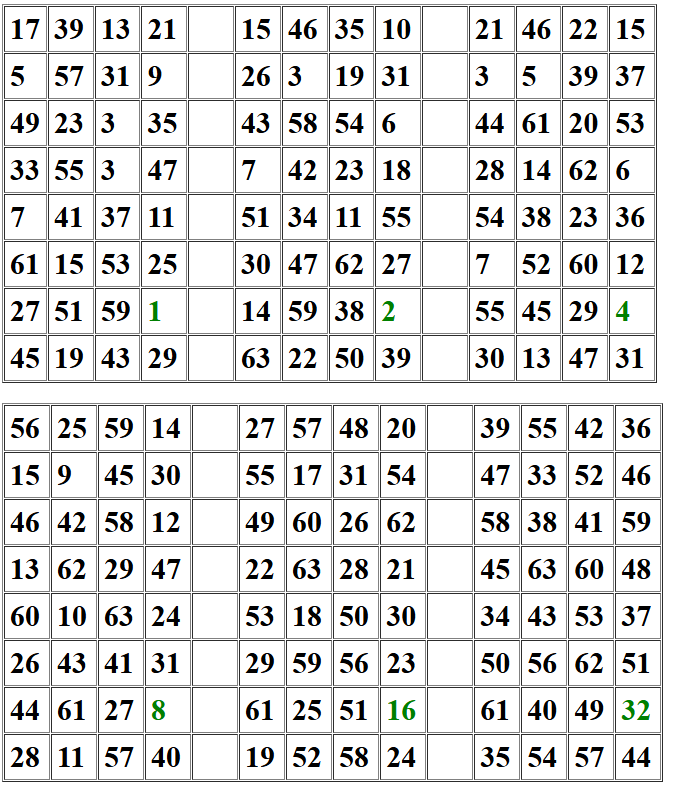
the Look at the numbers that are written with green color. They are the keys to the solution. If the person chose number 34 you should have cards with the numbers 32 and 2 in your hands. If the player chose number 62 you should have cards with 2, 4, 8, 16 and 32. When you add these numbers, you’ll get 62. You can replace green numbers if you want. But if you replace one to the left bottom corner you have to do the same with the others. And you also
can shuffle black numbers but only in the card. You can’t give more or take any of the numbers that are already on the card because then you won’t guess numbers.
Game 13 My Aunt
Ivana H.
The goal of this game is to guess what does my aunt like and what does she like not. The trick is hidden in the words. My aunt likes words with double vowels or consonants and she hates without it. Examples:
My aunt likes blood but she hates doctors.
My aunt likes stools but she hates chairs.
My aunt likes feet but she hates socks.
My aunt likes kittens but she hates cats.
My aunt likes moon but she hates sun.
If somebody say that my aunt likes something without double vowel or consonant speaker just say that she hates it.
Game 14 Hra na pašeráky
Peter Castek, Gymnázium, Teplice, Czech. rep.
,Jednou v létě pozdě večer hráli jsme si na dolejší návsi na podloudníky. Byli jsme tři – jeden stál na hromadě obecního klestí, které tam bylo připraveno k veřejné dražbě, a dělal pohraničního strážníka, zatím co druzí dva představovali pašeráky neboli podloudníky. Strážník chodil sem a tam po vrcholu hromady a napínal zrak i sluch, aby zabránil podlodníkům přejít ,lesnatý horský hřeben‘. Snadná služba to nebyla. Předně už byla tma a za druhé se podloudníci plazili tak tiše, že je ani neslišel, ani v té syté zeleni neviděl, a když na ně při obchůce zrovna nešlápl, jistě se mu na druhé straně vysmáli.
Obejít hromadu bylo prostě pod naší klukovskou čest a důstojnost, a také by nás takový podvod ani netěšil. Střídali jsme se, aby každý z nás ukázal, je-li lepší strážník než pašerák.” (Josef Lada, Vzpomínky z dětství.)
Hry na pašeráky patří dodnes k nejoblíbenějším zábavám. Les k nim ovšem dává lepší podmínky a náladu než náves. Čím je terén nepřehlednější, zarostlejší a nerovnější, tím líp. Ideální hranici tvoří klikatí potůček, který se dá překročit, nebo úzká lesní stezka.
Třetina hráčů představuje pašeráky, dvě třetiny pohraniční stráž. Stráž přechází v dvaceti metrovém pásmu před hraniční linií a chytá pašeráky, kteří se mají proplížit střeženým ůzemím a pronést kontraband – lísteček se svým podpisem. Kdo se dostane bezpečně za hranici, uloží lístek na smluveném místě pod kámen nebo do vykotlaného pařezu. Zpátky se vrací nejkratší cestou a bez skrývání. V pašeráckém doupěti, vzdáleném od hranice padesát až sto metrů, si vyzvedne další lístek a znovu se pokouší o tajný přechod hranice. Když ho některý pohraničník zahlédne a zvolá jeho jméno, musí mu odevzdat podepsaný lístek a vrátit se zpátky do pašeráckého doupěte pro nový papírek.
Třicet minut po zahájení hry se ozve ukončovací signál. Pak už jen zjistíte, kdo propašoval za potok nejvíc lístků a který ze strážců byl v lovu pašeráků nejúspěšnější.
Hrajete semozřejmě ještě dvakrát, nejen proto že je to ohromě napínavá hra, ale hlavně proto, že každý chce vyzkoušet obě role.
Vzpomeňte si na tu to hru, třeba až půjdete někam na výlet.
Game 15 Tristatricettri
Peter Castek, Gymnázium, Teplice, Czech. rep.
Vytrhni list linkovaného papíru školního sešitu a udělej na něm podle pravítka čtyřiatřicet svislých čar, jednu od druhé pět milimetrů. V každé se tak utvoří třiatřicet okének, do kterých budete vpisovat střídavě se soupeřem tiskacími písmenky slova.
Kdo hru zahajuje, musí říct nejdéle do deseti sekund jakékoliv české podstatné jméno v prvním pádu jednotného čísla, a pak toto slovo vepsat do prvních okének na první řádce – do každého okénka jedno písmeno. Potom je na řadě druhý hráč. Také on řekne podstatné jméno a zapíše je do dalších okének na první řádce. Časový limit se vztahuje jen na vyslovení podstatného jména, zápis už není omezen žádnou lhůtou. Další slovo se k předcházejícímu píše bez mezery.
Zvítězí ten, kdo svým slovem zaplní poslední, třiatřicáté okénko v řádce. Jestliže v něm jeho slovo skutečně končí, získává úspěšný hráč dva body. Pokud však písmenka poslední okénko přesáhnou a slovo je tedy nedokončené, hráč dostane jeden bod.
A hned začíná nové kolo hry. První na řadě je ten, kdo právě prohrál. Slova se teď vpisují do další řádky.
Body z jednotlivých kol se sčítají. Zvítězí ten, kdo bude mít po deseti nebo dvaceti kolech (podle předběžné dohody) vyšší bodový součet.
Hlavní princip hry tedy spočívá v tom, umět nejen pohotově vymýšlet kratší či dlouhá slova, ale promýšlet své i soupeřovy tahy dopředu.
Časový limit platí vždy od okamžiku, kdy předcházející hráč dopsal svoje slovo. Kdo nedokáže říct do deseti sekund nové podstatné jméno nebo řekne slovo už dříve ve hře použité, prohrál kolo a jeho soupeř dostane bod.
Game 16 Žužolenie, Hra na záhradníka, Hra na písmena
ZŠ Zuzkin park, Košice, Slovakia
Jeden z účastníkov si vymyslí nejaké sloveso. Ostatní sa pýtajú na to sloveso rôznymi otázkami, na ktoré sa dá odpovedať áno alebo nie. Ich úlohou je odhaliť, čo to je za sloveso. Napr. sloveso je : spať. Ostatní sa pýtajú: Žúžolíme doma? Odpoveď: áno aj. Žúžolíme aj mimo domu ? O: áno. Môžeme teraz žúžoliť ?
Vyhráva ten, kto prvý príde na dané sloveso.
Hra na záhradníka.
Každý hráč dostane meno kvetiny (ovocia…) a navzájom sa oboznámia so svojími
menami. Jeden (označenie záhradník – inak tiež ma pridelený aj názov kvetiny )
začne hru vyslovením vety: Šiel záhradník po záhrade a šľapol na …(povie meno
kvetiny) Začína sa dialóg medzi nimi.
Kvetina: jaj
záhradník: čo Ti je
kvetina: ľúbim ( pre pokročilejších rôzne zmysluplné sloveso)
záhradník: koho
kvetina: … ( meno inej kvetiny)
a tak to pokračuje dokola ( jaj / čo Ti je ….).
Dá sa dohodnúť, že kto “zaspí” dáva zálohu a na konci hry na záhradníka sa
pokračuje v hre na zálohy.
Hra na písmena.
Účastníci sedia v kruhu alebo si určia poradie.
Jeden z účastníkov povie slovo a každý nasledujúci musí pokračovať slovom,
ktoré začína na posledné písmeno predchádzajúceho slova. Slová sa nesmú
opakovať.Kto nevie pokračovať vypadne.
Game 17 Hra na Machácka
Martina, OA Martin, Slovakia
Game 18 Crazy notes,
A seaman who is looking for his wife, Statue of Love Oksana Boreiko and Katya Voronets, Belarus, Slonim, Gymnasium 1 mailto:gimn1slon@grodno.unibel.by
Crazy Notes”
“Crazy notes” is an ideal game in every situation. The number of participants:2-6. The rules:the participants should sit together making a circul. The answers to the questions should be written on the sheets of paper. When you’ll be ready with the answers you should wrap it up and give your list to the next participant.The others should the same.At the end of this game everybody reads the story which will be written on his list of paper. Some stories are very funny.
She(the same)
Where were they?
What did they do there?
What did he say?
What did she answer?
What was the end of the story?
A Seaman Who Is Looking For His Wife
This game is for teenagers (13-18)
This game can be played both outside and inside.
This game helps you to spend your freetime with funny and jokes, to be in good mood. For the game it is necessary that a number of boys should be equal to a number of girls(but not less than 5 both boys and girls).Besides it should be a person who explains the rules of the game(leader). Game:all boys go away. It is important that they can’t see and hear what is happening. At this momant the girls should choose their own numbers (1-5,6…). For example, if the girl chooses š1,her
“seamam” is the boy who will be the first to come in. And if she chooses š3, her “seaman” is the boy who will be the third t come in. The boys choose the order to come in themselves. When the first boy comes in, the leader tells him the following story:”You are an old sea wolf. You have been sailing so long that you even have forgotten how your wife looks like. Find your darling wife among these girls. Your heart, heart of the old seaman will prompt you where she is. When you regognize her, kiss her”. Durind the boy’s search,the girls do what they want but they shouldn’t prompt him anything.So at last he kisses one the girls and -if she has chosen another number she should give
him a slap in the face.Then the boy should continue his search. -if she has chosen his number she should kiss him too. The girl stays at her place, the boy stays not far from the girls. (It’s important that nobody thinks that this is his wife.) And now the boy’s aim is to kick another boy, who will kiss his wife while looking for his own wife. When the second boy finds his wife he also should stay with the first boy not far from the girls.His aim is also to kick another boy. The game is played in this way untill all seamen find their wives. Playing this game all participants are in good mood.
Statue Of Love
There are 2 leaders in the game.The 1st explains the rules to the participants,who will enter the room,because the participants exept two of them(a boy & a girl) with the 2nd leader should be outside. Then the 1st leader makes the statue of love with those participants, who stayed in the room.It is important that the statue should reflect “LOVE” of the people to each other. When the statue will be ready, the next participant ( a boy or a girl) should enter the room. When a boy or a girl enters the room they see the statue.And then the 1st leader tells him or her the following story:”You are a skulptor.You should make another statue of love of these two people.If you don’t like something in this statue you may change what you like.You can do with them everything you want.” When the statue will be ready, the leader should order the skulptor to take place of one of the participants of
the statue(boy instead of boy, girl instead of girl)The participant who leaves the game becomes a spectator. Then the next participant should enter the room. The participants should enter the room in the following way: girl-boy-girl-boy-girl-boy and so on or boy-girl-boy-girl-boy-girl and so on It is important that the participants shouldn’t know the rules of this game before playing.
Hry OA Bardejov
Aki sme vsimavi/Welche sind wir beachtet, Katarina Maruscakova, 2.A.
Akí sme všímaví, Tatiana Zeleňáková, 2.A,
Najprv si určíme trasu a potom po nej vedieme deti.
Keď prejdeme určitý úsek, zastavíme sa a urobíme prestávku.
Počas prestávky všetky deti napíšu na papier odpovede
na dané otázky.
- Aké zábradlie mal most, po ktorom sme prechádzali?
- Na ktorej strane cesty sa začal les skôr?
- Boli na kostolnej veži hodiny?
- Na ktorej strane bola rieka?
- Koľko ľudí sme stretli?
- Kde visela naša zástava?
Welche sind wir beachtet
Zuerst bestimmen wir eine Fahrstrecke und auf sie leiten wir die Kinder.
Wenn wir einen Abschnitt durchgehen, halten wir an und eine Pause tan.
Während der Pause schreiben alle Kinder auf das Papier die Antwor-
ten auf bestimmen Fragen auf.
- Welche Gelände hat die Brucke, wonach sind wir durchgegangen?
- Auf welcher Seite den Weg hat fruher der Wald sich angefangen?
- War die Uhr auf dem Kirchturm?
- Auf welcher Seite war der Fluss?
- Wie viele Leute haben wir getroffen?
- Wo hing unsere Fahne?
Lopta medzi kolenami. Popjaková Katarína, 2.A.
Najprv vytvoríme 2-3 družstvá. Prvý hráč má medzi kolenami loptu. Musí s loptou skákať k značke pred sebou, obísť ju a doskákať naspäť. Tu zoberie loptu ďalší člen družstva, vloží si ju medzi kolená a skáče ďalej. Tak sa vystrieda celé mužstvo. Víťazí družstvo, ktoré prvé doskáče do cieľa. V prípade, že niektorému členovi družstva počas skákania lopta vypadne, vráti sa s loptou na štart a opakuje to ešte raz.
Der Ball zwischen den Knie.
Zuerst schaffen wir 2-3 Mannschaften. Der erste Spieler hat zwischen den Knie den Ball. Er muss mit dem Ball vor sich zum zeichen springen, ihn und zuruck nachspringen umgehen. Hier nimmt den Ball der nachste Spieler ab, er gibt sich den Ball zwischen den Knie und er springt weiter. Derart lost es die ganze Mannschaft ab. Es gewinnt die Mannschaft, die als erste in das Ziel nachspringt. In dem Fall, dass dem Ball einigem Glied der Mannschaft fällt, er gibt sich mit dem Ball auf dem Start zuruck und er wiederholt das noch einmal.
Hľadaj svoju farbu. Ľudmila Tokarčíková, 2.A.
Medzi deti sediace v miestnosti, rozdáme určitý počet farebných lístkov. Potom z 2-3 hráčov, ktorých sme predtým poslali za dvere zavoláme jedného. Povieme mu, že medzi deťmi je určitý počet lístkov farby, ktorú sme mu určili. Vypytovaním sa u spoluhráčov, musí hráč získať všetky lístky “jeho” farby. Víťazí ten, ktorý všetky lístky získa čo najrýchlejšie.
Look for your colour.
We give away a certain number of colour cards among children sitting in a room. After that we call one of 2-3 players sent behind the door. We tell him there is a certain number of cards among the children of colour determined to him. The player has to get all cards of “his” colour by asking another players. The winner is a player, who gets all cards the most quickly.
Obrázková hra. Lukáš Slovík, 2A.
Deti dostanú kartičky s obrázkami (napr.: zvieratá , kvety, hračky,…). Sadnú si do kruhu. Jedna stolička je voľná. Dieťa vedľa voľnej stoličky hovorí napr.: ” Moje pravé (ľavé) miesto alebo moja pravá (ľavá) strana je voľná. Vyberám si psa (tulipán, bábiku) vedľa mňa. Dieťa s obrázkom psa (tulipána, bábiky) si sadne na voľné miesto a tak sa v hre pokračuje ďalej.
Spiel mit den Bildern
Die Kinder bekommen Kärtchen mit Bildern (z.B. Tiere, Blumen, Spielsachen,…). Sie sitzen im Kreis. Ein Stuhl ist leer. Das Kind neben dem leeren Stuhl sagt: z. B. “Mein rechter Platz (linker) oder meine rechte (linke) Seite ist leer. Ich wunsche mir einen Hund ( eine Tulpe, eine Puppe,…) neben mich. Das Kind mit dem Bild des Hundes (der Tulpe oder der Pupe) setzt dich an den leeren Stuhl und so setzt man weiter im Spiel fort.
Hra na slepú babu Maja Jutková
Táto hra sa hrá väčšinou vonku. V prípade nepriaznivého počasia sa hrá vo väčšej miestnosti. Hru hrá určitý počet hráčov. Vyberú si jedného. Ten nesmie nič vidieť. Zaviažu mu oči šatkou. On musí chytiť jedného hráča. Všetci pred ním utekajú, až dokiaľ jedného z nich nechytí. Potom chytá ten, ktorého chytila baba. Tak sa to opakuje dookola.
BLIND WOMAN
This game is usually played out. If it rains out, it can be played inside in a large room. The game is played by 8 or 9 players. The players choose one of them who will be a blind woman. He musnt see anything tidy. The rest of players tidy a kerchief over his eyes. His task is to catch one of the players who run close to him and shout at him e. g. Catch me. Who is caught, becomes next blind woman.
Hra s farbami. Mária Škriabová, 2.A
Deťom v izbe rozdáme farebne karty. Najprv pošleme 2-3 hráčov za dvere a potom jeden hráč príde naspäť. My povieme hráčovi, že musí farebné karty hľadať. On hľadá farebné karty s jednou farbou. Pýta sa spoluhráčov a musí skoro získať svoje farebné karty. víťaz je ten hráč, ktorý skoro získa farebné karty.
Spiele mit Farben.
Den Kinder verteilen im Zimmer die Farbkarten. Zuerst schinken wir 2-3 Spielern hinter den Turen und dann kommt ein Spieler zuruck. Wir sagen den Spieler, dass er die Farbkarten finden musst. Er findt die Farbkarten mit eine Farbe. Er fragt sich den Mitspielern und er musst bald seine Farbkarten gewinnen. Der Seiger ist dieses Spieler, der bald die Farbkarten gewinnen.
NA ZVERINEC, Martina Kyjovská, 2.A
Medzi deti rozdelíme lístky, ktoré si vopred pripravíme. Na každom lístku je názov zvieraťa. To znamená, že má napríklad 5 deti názov pes, 5 názov mačka, 5 názov koza, 5 názov kohút atď. Na povel vedúceho začnú všetky deti vydávať zvuk, charakteristický pre zviera, ktoré majú predstavovať. Víťazí tá skupina, ktorá sa vo všeobecnom zmätku ako prvá nájde.
ON THE GAME
We divide prepared tickets among children. Every tickets has a name of some animal. It means that for example: five childnen have a dog, five a cat, five a goat, five a cock etc. All children start to make sounds. Characteristical for the animal, which they have to intruduce. The winner is this group which is the first completel in general mess.
Víchrica, Milan Olejár, 2.A
Vedúci rozdelí hráčov do dvoch družstiev, ktoré stoja na protiľahlých stranách stola. Do stredu stola položí stolnotenisovú loptičku. Úlohou hráčov je odfúknuť loptičku na protiľahlú stranu stola. Družstvo ktorému sa to podarí získa bod. Ak loptička spadne na niektorej priľahlej strane stola, bod nezíska nijaké družstvo. Hráči sa pri hre nesmú pohnúť z miesta. Vyhrá družstvo, ktoré prvé získa desať bodov.
The hurricane
The chief divides the players into the two groups. they stay on opposite sides of table. There is a table tennis ball in the middle of the table. The task players of the groups is blowing. away the ball on the opposite side till the edge of the table. There is one point for the sucessful group. If the ball falls down on some adjacent side of tha table there won´t be the point for the groups. The players haven´t to move from their position during the game. If the group has got ten points it will be the victorious group.
Základná naháňačka
Hráč, ktorý chytá, sa snaží dobehnúť niektorého spoluhráča a dotknúť sa ho. Ten ho v chytaní vystrieda, alebo naháňajú spolu. Najšikovnejší je ten účastník hry, ktorého chytia nakoniec.Naháňačky s rôznymi spôsobmi behu – na jednej nohe súnožno po štyroch v dvojiciach alebo v trojiciach znásobená naháňačka, keď sa chytený pridá k tým, čo naháňajú
The basic chasing
A player that is catching, wants to catch any player and fouch him. This player will substitute him or thex are catching together. The elevest player is this that is catched as the lasted. The game can be played in a any variantsof running on one foot on two foots in pairs or at triple teams
We are. Tatiana Zeleňáková, 2.A.
First we prepare a way, than we guide children. When we pass the way, we stop and make a break. During the break, each of children write answers on questions on piece of paper (questions should by 7-10)
- Which colours was the railing?
- Where did the wood start earlier?
- Was there a clock on a church´s tower & similar questions.
Lopta medzi kolenami/Der Ball zwischen den Knie. Popjakova Katarina, 2.A.
Hladaj svoju farbu/Look for your colour. Ludmila Tokarcikova, 2.A.
Obrazkova hra/Spiel mit den Bildern. Lukas Slovak, 2A.
Hra na slepu babu/BLIND WOMAN Maja Jutkova
Hra s farbami/Spiele mit Farben. Maria Skriabova, 2.A
Vichrica/ The hurricane, Milan Olejar, 2.A
Zakladna nahanacka/The basic chasing
We are. Tatiana Zelnakova 2.A.
GAMES from OA Bardejov (Land, LIGHTS IN THE DARK, ANIMAL PLAY, HIDDEN THING)
GAMES from OA Bardejov
POLOVNÍK, Edita Krupska
PRASKNI BALÓNIK/ZERPLATZ DEN BALLON, Kuceravá, 2.A,
Boj o poklad/Der Kampf um den Schatzt. Jana Górzynska 2.A
STOLICKY/Chairs, Marianna Hrkelová, 2. A
Cokoláda/ Die Schokolade, Mária Balašcáková, 2. A
Co tam nepatrí/Was dort gehort nicht, Peter Adamišin, 2. A
Dlhý nos/Long nose, Slavka Benova
Lístky/Tickets, Slavka Dvorcakova
Na zverinec/ Auf dem Tiergarten., Slavomíra Kohutová, 2.A.
PREZLIEKANIE/ Changing clothes Zuzana Vaskova
Free time game from Romania
Diana Deaca & Alina Boitan 17 Years Old “Mihai Eminescu” Highschool Calarasi – Romania Coord. Olga Buzea & Ioana Dumitru ioana_d@lme.nex.ro
It is a normal day. I am standing here staring at the walls.My basedom reached its highest point. I was about to explode when salvation appeared. God sent me one of His messangers and showed me that He hadn’t forgotten me. God works in misterious ways, so His messanger was my friend Alina. She saw I wasn’t in a good mood so she proposed we should start a game. I agreed. We began and then we stopped. I had no idea what the game was about. So she explained it to me. She would tell me five features of a personality and I should guess who it was. “Nothing easier” I said and then I was wrong. Again. To play this game one has to have some knowledge in almost all the domains. And how can you reach this level of culture? someone could ask. Simple! By reading. People usually run away from reading, they find it a waste of their time. But we easily can consider reading as a game that could fill up our free time. So, instead of fooling around, playing stupid games (not like the one we were playing), you should read! It is impossible for someone not to find something to like , something that fits his personality. And, as a conclusion, my friend and I, find a new game , funnier and more interesting than any other game. I advice everybody to read, if they don’t. And if they do, then congratulations!
You are playing a beautiful game! Keep doing it!
HELLO FROM REPUBLIC OF GEORGIA
Ann Khrikadze, Grammar school, Rustavi, Georgia, I*EARN teacher: Pavle Tvaliashvili
tvaliashvili@hotmail.com
I want to introduce to you play which is called: “Rad, Yellow, and Black”.
The name if quite funny-isn’t it? So, this play requires approximately 10 children or even more. One of them must close his or her eyes, and another one call the three other children the names of colours-red, yellow and black. Each colour has its own meaning: red means-kissing, yellow-a guestion, and black-beating. Then, that child must open his eyes and choose one colour, and on base of his choice he will get a kiss, a questiw or a beating. Then the chosew “color” will close his eyes and the same recpeats again and again.
SPACE TIME GAME
grfiveteen_shadia@yahoo.com
Do you know how to intertaine and enjoy yourself ? We find to you the solution. You have to practice different games .
- can you join these two paper-clips without touching them?
- No, I can’t .
Follow these instructions :-
1 First, cut a strip from a piece of paper, like this.
2 Then fold the strip and put one paper-clip here.
3 Next , fold the strip again and put the other paper – Clip here. Don’t touch the paper-clips again .
4 finally, pull both ends of the strip .